
Asthma
Asthma is a common lung condition. In fact, about 10 percent of adults and 20 percent of children suffer from this condition. Even though it often starts in childhood, people can develop the symptoms of asthma at any age.

Translations are automatic (Google Translate) and may contain errors. English is the original.
Watch: Asthma in 90 seconds
From the Medinformer YouTube channel. Watch on YouTube
COUGHING, WHEEZING, TIGHT CHEST, SHORTNESS OF BREATH?
What is Asthma?
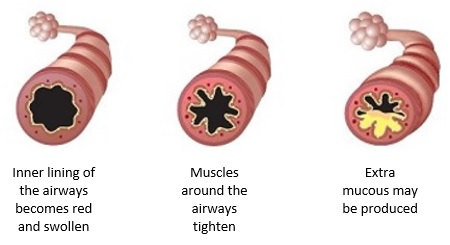
What are the signs and symptoms of asthma?
The causes of an asthma attack.
Even though almost anything can trigger an asthma attack, the following are some of the most common triggers:
- House dust.
- Insecticides.
- Cigarette and other smoke.
- Animals with fur.
- Emotions.
- Plant pollen.
- Weather changes.
- Colds.
- Physical strain.
In the event of an asthma attack, do the following:
- Stay calm and try not to panic.
- Breathe as slowly and deeply as possible.
- Take your prescribed medication.
- Check your breathing with a peak flow meter (if your doctor has advised you to do so).
- Ask someone to call your doctor if you have difficulty speaking.
- Above all, DO NOT ignore the problem.
What is the diagnosis and treatment of asthma?
Even though doctors cannot cure this respiratory disorder, you can lead a normal life without your condition limiting you, if you manage it properly, Therefore, in order to keep your symptoms under control, it is important to understand the types of treatment available:
Firstly, reliever medication gives instant relief for a short period of time (4 – 6 hours). It only works on the smooth muscles around the airways and not on the membranes lining the insides of the tiny tubes.
Secondly, controller medication works on the lining of the airways. It does not give immediate relief. However, when used every day over prolonged periods of time, it controls the redness, swelling and mucous production on the inside of the breathing tubes. Therefore, it controls symptoms, prevents severe attacks and prevents long-term damage to the airways.
In short, you need to speak to your doctor about the best treatment for you. He or she will advise on ways to manage your symptoms including how and when to take your medication.
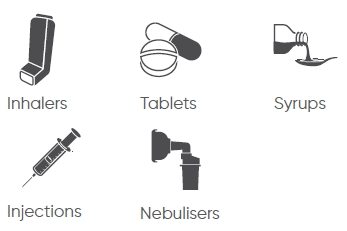
Ways to take your medication:
Asthma management tips
- Take your medication as prescribed.
- Avoid triggers where possible.
- Visit your doctor regularly.
- Lead an active life (get regular exercise).
- Pay attention to the signs and symptoms of asthma.
Inhalers
Doctors consider inhalers to be the best way to treat asthma, and they are safe to use. Long-term continual use helps asthmatics breathe properly and lead a normal life.
However, many people with this condition do not get the full benefit of using inhalers. This is because they do not do the following.- Comply with treatment: Taking medication as prescribed and not stopping without consulting their doctor.
- Use their inhaler correctly: Different inhalers require different techniques. Consequently, it is essential that a healthcare professional shows you how to use your inhaler correctly. On the other hand, incorrect inhaler technique is one of the major reasons for uncontrolled asthma.
The BronkiBoosters are here to help when it comes to managing your asthma and how to use your inhaler to its full potential. Let the battle for air begin!


Print, download or find out more
Medical references
Global Initiative for Asthma.
Global Strategy for Asthma Management and Prevention, 2017. Available from: www.ginasthma.org

This page is for general information and isn't a substitute for advice from a doctor who knows your history. If you're worried about your health, speak to your GP. In an emergency, call 10177, or 112 from a mobile.