

Read in
Translations are automatic (Google Translate) and may contain errors. English is the original.
What causes vaginal thrush?
While any woman can experience vaginal thrush, there are certain conditions that increase the risk of developing the infection, these can include:1
- Pregnancy
- Antibiotic use
- Chemotherapy (cancer medication)
- Diabetes
What are the signs or symptoms?
Signs of thrush can include:1
- Abnormal discharge
- Itching or burning
- Redness, soreness and swelling
- Painful urination and/or sex
Recurrent vaginal thrush is when a woman experiences 4 or more episodes of thrush in a 12 month period.1
Treating thrush
Vaginal thrush can be treated with over-the-counter medications or with prescribed antifungals. Such medications can be topical or oral (taken by mouth).1
 Combining pharmaceutical medicines with probiotics can be a way to better manage common genital infections.2a
Combining pharmaceutical medicines with probiotics can be a way to better manage common genital infections.2aHow can a probiotic help for vaginal thrush?
The microorganisms that inhabit the vagina play a major role in the maintenance of health of a woman.3
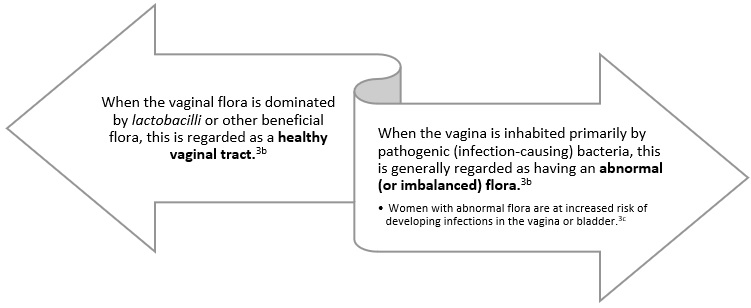 Probiotics help to restore and maintain a healthy vaginal flora and prevent genital infections such as thrush.3,4
Daily intake of selected probiotics can stabilise the fluctuating vaginal flora and lower the risk of infections in healthy women as well as those prone to urogenital infections.3
Probiotics help to restore and maintain a healthy vaginal flora and prevent genital infections such as thrush.3,4
Daily intake of selected probiotics can stabilise the fluctuating vaginal flora and lower the risk of infections in healthy women as well as those prone to urogenital infections.3
Probiotics help to restore and maintain a healthy vaginal flora and prevent genital infections such as thrush.3,4
Daily intake of selected probiotics can stabilise the fluctuating vaginal flora and lower the risk of infections in healthy women as well as those prone to urogenital infections.3The benefits of probiotics are ‘species or strain-specific’
Probiotics have numerous health-promoting activities, however different probiotics can have different health effects.3 When choosing a probiotic, ensure it has proven effects in the condition(s) you are preventing or treating.5

Medical references
- Wright M. Vaginal and Vulval Candidiasis. Professional Articles on Infectious Diseases [Last edited August 16, 2019]. Available from: https://patient.info/doctor/vaginal-and-vulval-candidiasis Accessed August 2020.
- Martinez RCR, et al. Improved cure of bacterial vaginosis with single dose of tinidazole (2 g), Lactobacillus rhamnosus GR-1 and Lactobacillus reuteri RC-14: a randomised, double-blind, placebo-controlled trial. Can J Microbiol 2009;55:133-138.
- Reid G, Charbonneau D, Erb J, et al. Oral use of Lactobacillus rhamnosus GR-1 and L. fermentum RC-14 significantly alters vaginal flora: randomized, placebo-controlled trial in 64 healthy women. FEMS Immunology and Medical Microbiology 2003:35:131-134.
- Reuterina femme® Approved Package Insert, December 2009.
- Gardiner GE, Heinemann C, Bruce AW, et al. Persistence of Lactobacillus fermentum RC-14 and Lactobacillus rhamnosus GR-1 but Not L. rhamnosus GG in the Human Vagina as Demonstrated by Randomly Amplified Polymorphic DNA. CLIN. DIAGN. LAB. IMMUNOL. 2002;9(1):92–96.066 ZA Reut 112020

This page is for general information and isn't a substitute for advice from a doctor who knows your history. If you're worried about your health, speak to your GP. In an emergency, call 10177, or 112 from a mobile.